

Two lenders offer you capital for your El Paso business. One quotes a 1.28 factor rate. The other quotes 28% APR. Which is cheaper? Most business owners get this wrong — and the gap between the right and wrong answer can be tens of thousands of dollars. Factor rates and APR measure cost in completely different ways, and without converting both to the same metric, you cannot make a rational comparison.
This guide covers every cost metric used in business financing — APR, factor rate, total cost of capital, holdback percentage, and effective yield — explains what each actually measures, and gives you the conversion formulas to reduce any offer to a single comparable number. It also explains the specific disclosure gap in Texas that leaves El Paso business owners without the protections that consumer borrowers receive.
The Core Conversion Formula
Factor Rate → APR:
APR ≈ (Factor Rate − 1) ÷ Term in Years × 100
Examples at the same 1.28 factor rate:
- Repaid in 3 months (0.25 yr): APR ≈ (0.28 ÷ 0.25) × 100 = 112% APR
- Repaid in 6 months (0.5 yr): APR ≈ (0.28 ÷ 0.5) × 100 = 56% APR
- Repaid in 12 months (1 yr): APR ≈ (0.28 ÷ 1.0) × 100 = 28% APR
The same factor rate = wildly different APRs depending on repayment speed.
Metric 1: APR (Annual Percentage Rate)
APR is the standardized annual cost of borrowing, expressed as a percentage of the principal, that includes both interest and fees. It normalizes cost across different loan structures, terms, and fee arrangements — making it the only metric that allows true apples-to-apples comparison between a bank loan, an online term loan, and an SBA product.
When APR is meaningful: For any loan with a fixed term and scheduled payments — term loans, SBA loans, lines of credit, equipment loans. The lender can and should provide APR directly.
When APR is misleading: For revenue-based financing and MCAs with variable repayment (holdback percentage), the actual repayment term varies based on how fast your revenue runs. A 15% holdback on a strong revenue month pays off faster; on a slow month, slower. APR fluctuates accordingly — a "15% holdback" advance on a business with volatile revenue might repay in 3 months one time and 9 months the next, creating completely different APR outcomes from the same product.
Metric 2: Factor Rate
A factor rate is a simple multiplier — not an interest rate. Multiply your advance amount by the factor rate to get total repayment. Factor rate math is deceptively simple, which is why it's used to obscure cost.
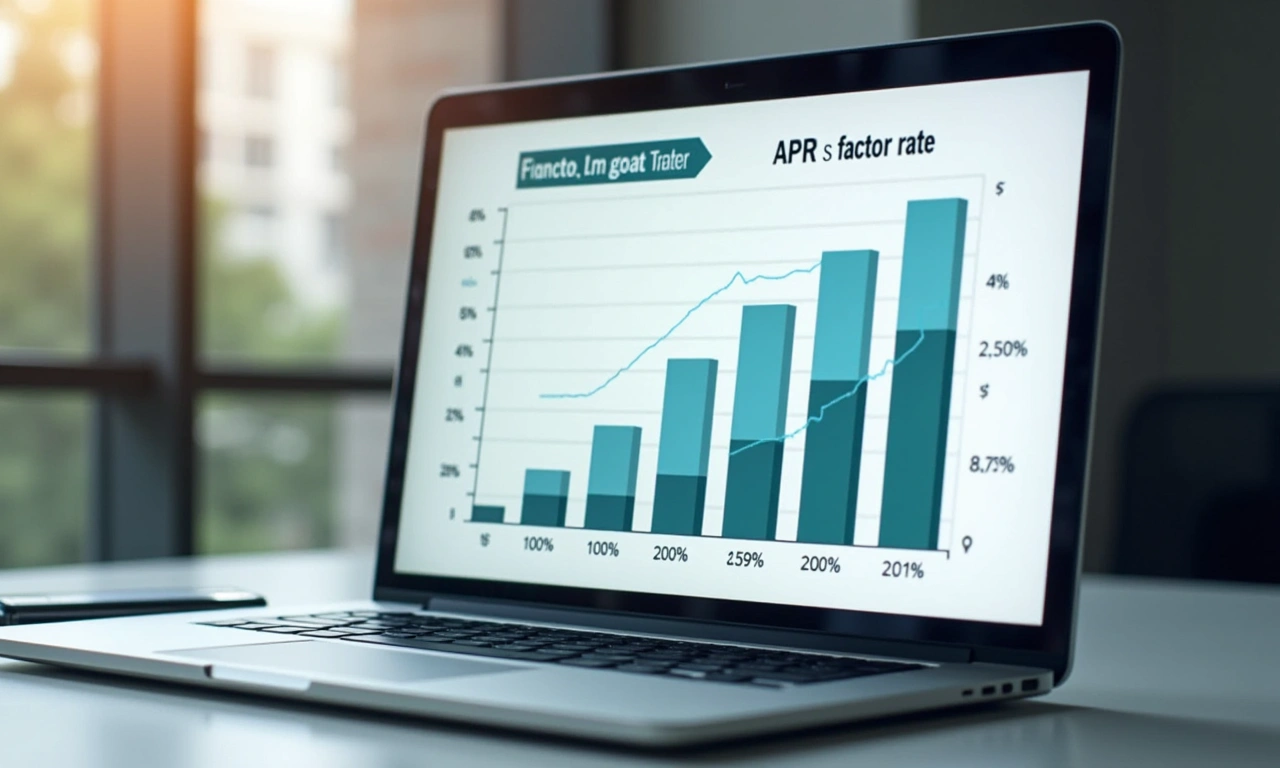
| Factor Rate | $50K Advance — Total Repayment | Dollar Cost | APR if 3-month term | APR if 6-month term | APR if 12-month term |
|---|---|---|---|---|---|
| 1.10 | $55,000 | $5,000 | 40% | 20% | 10% |
| 1.20 | $60,000 | $10,000 | 80% | 40% | 20% |
| 1.30 | $65,000 | $15,000 | 120% | 60% | 30% |
| 1.40 | $70,000 | $20,000 | 160% | 80% | 40% |
| 1.49 | $74,500 | $24,500 | 196% | 98% | 49% |
Metric 3: Total Cost of Capital (TCC)
Total Cost of Capital answers the simplest question: how many dollars above principal do I pay for this loan? It's the most honest metric for comparing a short-term high-APR product against a long-term low-APR product when cash flow impact matters more than rate efficiency.
| Product ($100K) | APR | Term | Total Repayment | Total Cost (TCC) | Mo. Payment |
|---|---|---|---|---|---|
| SBA 7(a) @ 10.25% | 10.25% | 10 yr | $159,600 | $59,600 | $1,330 |
| TSBCI Bank @ 8.5% | 8.5% | 5 yr | $123,000 | $23,000 | $2,050 |
| Online Term Loan @ 30% | 30% | 2 yr | $134,800 | $34,800 | $5,617 |
| RBF — 1.25 factor (6 mo) | ~50% | 6 mo | $125,000 | $25,000 | ~$20,800 |
| MCA — 1.40 factor (4 mo) | ~120% | 4 mo | $140,000 | $40,000 | ~$35,000 |
*Illustrative figures. Actual costs depend on specific lender terms and repayment pace.
Metric 4: Holdback Percentage
For MCAs and revenue-based financing, the holdback (or retrieval rate) determines how fast you repay — which in turn determines the effective APR. The holdback is a percentage of daily or weekly revenue automatically swept to the lender.
How holdback interacts with business health: A 12% holdback on $60,000/month in revenue = $7,200/month in repayments. That same 12% on a month where revenue drops to $35,000 = $4,200/month. The advance technically has "flexible" repayment because the holdback adjusts with revenue — but the remaining balance still accrues the same total cost regardless of how slowly it repays.
Maximum safe holdback by revenue level:
| Monthly Revenue | Max Recommended Combined Holdback | Max Daily Sweep (30-day month) | Why This Limit |
|---|---|---|---|
| $20,000 | 10%–12% | $67–$80/day | Tight margin; leaves ~$1,800 for ops after sweep |
| $50,000 | 12%–15% | $200–$250/day | Moderate scale; 85%–88% remains for expenses |
| $100,000 | 15%–18% | $500–$600/day | Higher revenue = more buffer; still needs review |
| $200,000+ | Up to 20% | $1,333+/day | Only safe if margins are 40%+; monitor monthly |
"In Texas, business lenders are not required to disclose APR on commercial financing — only consumer lenders have that obligation. This means an El Paso business owner comparing a 1.30 factor rate MCA to a 28% APR online loan is comparing apples to oranges without converting to a common metric. Always ask: 'What is my total repayment amount and what is the expected repayment term?' Those two numbers are enough to calculate TCC and estimate APR, regardless of what the lender calls the cost."
— Franklin Funding Team, El Paso Business Finance Advisory
Want to Know the True Cost Before You Sign?
Franklin Funding provides transparent cost comparisons across every financing option available to your El Paso business — APR, TCC, and monthly cash flow impact, side by side.
Get a Transparent Cost Comparison ➜The Texas Disclosure Gap: What El Paso Borrowers Should Know
The federal Truth in Lending Act (TILA, 15 U.S.C. § 1601) requires APR disclosure on consumer credit — personal loans, mortgages, auto loans, credit cards. Business loans are explicitly excluded from TILA. As of 2026, Texas has not enacted a commercial financing disclosure law. This means:
- A Texas MCA lender can quote a factor rate without disclosing the equivalent APR
- A revenue-based financing lender can quote a holdback percentage without disclosing total cost of capital
- There is no legal requirement to disclose prepayment terms, origination fees as APR components, or true total repayment obligations in standardized form
States with commercial financing disclosure laws (California, New York, Utah, Virginia, Florida) require APR-equivalent disclosures on all business financing over certain thresholds. El Paso businesses should proactively request written disclosure of: (1) total repayment amount, (2) origination and all fees, (3) repayment term assumption, (4) any prepayment benefit or penalty. Then calculate TCC and estimate APR using the formula in this guide before signing.
Checklist: Evaluating Any Financing Offer
- ✓ Get the total repayment amount in writing — not just the factor rate or interest rate
- ✓ Calculate TCC = Total Repayment − Principal
- ✓ Confirm the expected repayment term — essential for APR conversion
- ✓ Convert to APR using: (Factor Rate − 1) ÷ Term in Years × 100
- ✓ List all fees — origination, wire, ACH, monthly minimum, early termination
- ✓ Calculate monthly cash flow impact — compare to your average monthly net income
- ✓ Confirm prepayment terms — do you get a discount for early payoff? (Many MCAs: no)
- ✓ Compare at least 2 offers — never sign from a single source under time pressure
Frequently Asked Questions: APR vs Factor Rate El Paso
What is a factor rate and how do I convert it to APR?
A factor rate is a cost multiplier: advance × factor rate = total repayment. Convert to APR: (Factor Rate − 1) ÷ Term in Years × 100. A 1.28 factor rate paid back in 6 months = 56% APR; the same rate paid in 12 months = 28% APR. Repayment speed is everything.
What is the difference between APR and total cost of capital?
APR is the annualized rate — useful for comparing cost efficiency. Total Cost of Capital is the actual dollar amount above principal you pay — useful for understanding real business impact. A 10-year SBA loan at 10% APR costs more total dollars than a 3-month RBF at 50% APR on the same principal.
What is a holdback percentage?
The holdback is the percentage of daily or weekly revenue swept to an MCA or RBF lender as repayment. A 12% holdback on $50K/month = $6,000/month in payments. Combined holdbacks above 15%–20% of monthly revenue create strain for most El Paso businesses.
Are Texas lenders required to disclose APR on business loans?
No. Texas has not enacted a commercial financing disclosure law. Business lenders in Texas are not required to disclose APR — only consumer lenders are. Always request total repayment amount and expected term in writing, then calculate APR yourself before signing.
How do I compare an SBA loan to a revenue-based financing offer?
Convert both to APR and TCC at your specific use case. If you're borrowing for 6 months: SBA isn't available in 6 months, so compare RBF TCC ($25K on a 1.25 factor) against an online term loan at 30% APR ($7,500 TCC in 6 months). TCC often favors shorter-term products for shorter-term needs.
FTC Guidance: The Federal Trade Commission has published resources on understanding small business financing costs and identifying deceptive practices in commercial lending. See ftc.gov/business-guidance/small-businesses.
Federal Reserve Research: The 2024 Small Business Credit Survey found that high-cost financing products were disproportionately used by businesses with lower revenue and credit scores — underscoring the importance of transparent cost comparison before signing. Source: fedsmallbusiness.org.
Financial Disclaimer: This article is for educational purposes only and does not constitute financial or legal advice. APR conversion formulas are approximations; actual APR may differ based on compounding method, fee inclusion, and lender-specific calculation methodology. Texas business lending is not subject to federal TILA APR disclosure requirements. Consult a licensed financial advisor before signing any commercial financing agreement. Franklin Funding is not a licensed lender. See our affiliate disclosure.